Mar 17, 2013; Bristol, TN, USA; NASCAR officials try to break up a fight between the crews for Sprint Cup Series drivers Denny Hamlin (11) and Joey Logano (22) after the Food City 500 at Bristol Motor Speedway. Mandatory Credit: Randy Sartin-USA TODAY Sports
NASCAR has never been completely comfortable with the idea of removing emotion from racing and it has never been short of famous confrontations. Kyle Busch and Ricky Stenhouse Jr. made headlines after their 2024 All-Star Race clash, Jeff Gordon and Brad Keselowski were involved in a major 2014 garage brawl, and Jimmy Spencer and Kurt Busch had their own infamous clash in 2003. Even Kyle Busch and Richard Childress made NASCAR history with their 2011 confrontation and then again Busch and Joey Logano in 2017. These moments have become part of the sport’s identity.
Recently, CEO Steve O’Donnell revealed he was fine with drivers handling their own disagreements after a race. His concern starts when the crews get involved.
Speaking on the Racin’ With the Boys podcast, O’Donnell explained why NASCAR has moved away from automatically punishing every driver confrontation.
“I’m okay with it. I think that’s fair,” O’Donnell said. He argues that drivers are going to get angry when they race each other hard. Sometimes that frustration does not end when the checkered flag falls. O’Donnell believes there is value in allowing those emotions to come through because rivalries can give fans another reason to follow the sport.
“Our drivers, some of them get that, some of them don’t want to be that guy, and that’s okay. But we need rivalries, we need villains, any sport — you need personalities. You need a reason to care.” That is particularly relevant with Carson Hocevar.
Hocevar has developed a reputation for aggressive racing and has been at the center of several rivalries during the 2026 season. His tension with Corey Heim has become one of the more noticeable driver-versus-driver storylines in the Cup Series.
O’Donnell does not appear to believe NASCAR should take that personality away from him. “With Hocevar, to me, he’s doing everything we would want from a driver getting out there.”
But that does not mean NASCAR wants fights to become uncontrolled brawls.
NASCAR’s Approach Is Different From Other Major Series
This is where NASCAR stands apart.
The FIA’s current International Sporting Code gives officials broad authority to penalize misconduct, unsportsmanlike behavior, unsafe acts and conduct that harms the interests or reputation of motor sport. The FIA also maintains specific penalty guidelines through Appendix B.
IndyCar also has broad rules covering conduct that can amount to unsportsmanlike behavior or conduct detrimental to racing and the organization.
IMSA takes a similar professional-conduct approach. Its 2026 regulations state that members are expected to behave professionally and sportsmanlike, with inappropriate or unsafe conduct potentially resulting in penalties.
So the difference is not that NASCAR has no rules. It’s more about how much room NASCAR is willing to give its drivers to settle their own disputes.
O’Donnell specifically drew the line at crew members becoming involved.
“Where we’re at is, if the drivers want to handle their business, great. When the crew guys start piling on, that’s when we’ve got a challenge.”
He explained that NASCAR previously went through a period where too many fines were handed out, while confrontations could become dangerous when larger crew members joined in. A driver confronting another driver after a race is one thing. A group of crew members surrounding a driver is something completely different.
That may also explain why NASCAR is willing to embrace drivers who create genuine rivalries.
In Formula 1, IndyCar and sports car racing, officials have formal conduct rules that can be used when incidents cross the line. NASCAR has those rules too, but O’Donnell’s comments suggest the series does not want to automatically treat every heated driver confrontation as something that needs to be eliminated.
For NASCAR, the argument is that emotion creates stories. A rivalry gives fans someone to root for. An aggressive driver creates debate. A disagreement can turn one race into a storyline that carries into the next.
And O’Donnell believes NASCAR needs exactly that. “We need rivalries, we need villains, any sport — you need personalities. You need a reason to care.”
Fans Don’t Seem to Want NASCAR Without the Drama
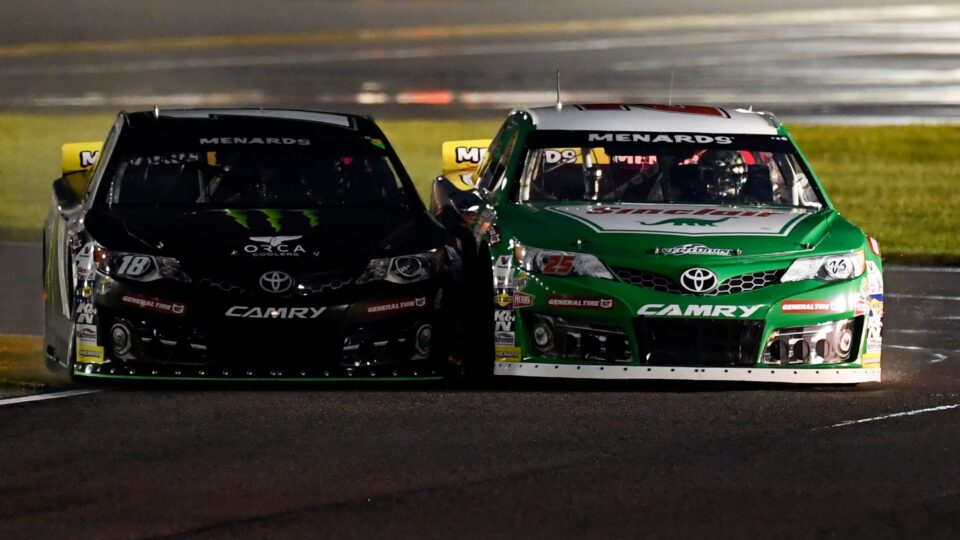
Aug 14, 2020; Daytona, Florida, United States; Arca cup series driver Michael Self (25) fights for the lead with driver Ty Gibs during the General Tire 100 at Daytona Road Course. Mandatory Credit: Douglas DeFelice-USA TODAY Sports
There is another part of this debate that NASCAR cannot really ignore: fans watch the drama too.
A hard-fought race can create a rivalry, but a confrontation after the checkered flag can turn that rivalry into a storyline that carries into the next weekend. That is especially true in NASCAR, where the line between racing and personal competition has always been part of the sport’s identity.
Tony Stewart once summed up the business side of it pretty well: “Anytime there’s a fight after a race, NASCAR is going cha-ching. The track, whoever. The track next week is going cha-ching. The network is going cha-ching.”
That does not mean every fan wants drivers throwing punches. But it does explain why these moments receive so much attention. Even the most worried fans will get a little curious and check the video.
A fight can dominate social media, become the main talking point after a race and give fans a reason to watch the next event to see what happens between the two drivers.
That is also where NASCAR sometimes finds itself in a “hypocritical” position. The organization can punish a driver for crossing the line, then later use footage of the same confrontation in social media posts, promotional videos or coverage because it knows the moment attracts attention.
Fans have called out that contradiction before. The reaction is essentially: if NASCAR knows these moments create interest, why pretend the emotion itself is the problem?
There still seems to be a line, though. Even fans who enjoy the drama can turn against a driver when a confrontation feels unfair or dangerous. Crew members piling onto one driver can change the entire perception of an incident. So can attacking someone who is not in a position to defend themselves.
That actually lines up closely with O’Donnell’s position.
NASCAR wants personalities. It wants rivalries. It wants drivers that fans love, drivers that fans hate and drivers that give people something to argue about Monday morning.
For now, O’Donnell seems comfortable with letting the drivers bring the heat – as long as the crews stay out of it.